How to Reduce Customer Acquisition Cost: 10 Proven Strategies
If you've watched your ad spend climb while your customer numbers stay flat, you're not alone. Across nearly every industry, businesses are asking the same question: how to reduce customer acquisition cost without sacrificing growth.
Customer Acquisition Cost (CAC) is one of the most important numbers in your business. It tells you exactly how much you're paying to win each new customer—and whether your marketing engine is actually profitable. When CAC creeps up faster than your customer lifetime value (LTV), even a business with strong revenue can quietly bleed money.
The good news? Reducing CAC doesn't mean spending less on marketing. It means spending smarter. In this guide, we'll break down what CAC really is, why it keeps rising, and ten practical strategies you can use today to bring it back under control.
What is Customer Acquisition Cost?
Customer Acquisition Cost is the total amount you spend to acquire a single new customer. The formula is simple:
CAC = Total Marketing and Sales Spend ÷ Number of New Customers
Your "total spend" should include everything tied to acquisition: ad spend, salaries for marketing and sales staff, software and tools, agency fees, and creative production costs.
For example, if you spent $20,000 on marketing and sales in a month and gained 200 new customers, your CAC would be $100 per customer. If your average customer is worth $400 over their lifetime, that's a healthy ratio. If they're only worth $120, you have a problem.
Why is CAC Increasing?
Most businesses aren't dealing with one issue—they're dealing with several at once:
- Rising ad costs across Meta, Google, and other major platforms
- Increased competition bidding for the same audiences
- Creative fatigue, where ads stop performing because audiences have seen them too many times
- Poor audience targeting that wastes budget on uninterested users
- Inefficient sales funnels that lose leads before they convert
- Low conversion rates on landing pages and checkout flows
- Weak customer retention, which forces constant reinvestment in new customer acquisition
Understanding which of these is hurting you most is the first step toward fixing it.
10 Proven Ways to Reduce Customer Acquisition Cost
1. Improve Audience Targeting
Use first-party customer data to understand who your best customers actually are, then build lookalike audiences based on those profiles. Segmenting campaigns by behavior, demographics, or purchase history ensures your budget reaches people who are genuinely likely to convert.
2. Optimize Landing Pages
A slow or confusing landing page can undo all your hard work in acquisition. Focus on faster load times, a clear and singular call-to-action, a smooth user experience, and full mobile optimization. Even small improvements here can meaningfully lower your cost per conversion.
3. Invest in Content Marketing
SEO blogs and educational content build organic traffic that doesn't depend on ad spend. While content marketing takes longer to show results, it compounds over time—making it one of the most reliable long-term levers for CAC optimization.
4. Focus on Customer Retention
Acquiring a new customer is almost always more expensive than keeping one. Email marketing, loyalty programs, referral incentives, and upselling existing customers all increase LTV, which improves your CAC-to-LTV ratio without spending another dollar on acquisition.
5. Leverage Marketing Automation
Automated email sequences, CRM integrations, and lead nurturing workflows let you guide prospects toward conversion without manual effort. This reduces wasted spend on leads that simply needed more time and the right follow-up.
6. Continuously A/B Test Campaigns
Testing isn't optional—it's how you find what actually works. Run structured tests on headlines, images, videos, CTAs, and landing pages. Small, consistent wins from testing add up to meaningful CAC reductions over time.
7. Use AI for Ad Creative Production
One of the most overlooked drivers of high CAC is creative fatigue. When the same ads run for too long, click-through rates drop, conversion rates fall, and ROAS suffers—all of which drive acquisition costs up.
Fresh, varied creative consistently improves CTR, conversion rates, and ROAS, which directly lowers acquisition costs. The challenge has always been production speed: traditional creative workflows are slow and expensive, making it hard to keep up with the pace audiences demand.
This is where AI ad creative optimization comes in. Dilogs AI helps businesses create multiple high-quality ad creatives quickly, enabling marketers to test more variations without significantly increasing production costs. By reducing creative turnaround time and combating ad fatigue, brands can improve campaign performance and lower customer acquisition costs.
The benefits of ad creative automation extend beyond speed:
- Faster creative generation for time-sensitive campaigns
- Scalable ad production across multiple platforms and formats
- Better campaign testing with more creative variations
- Improved overall marketing efficiency
8. Optimize Your Sales Funnel
Map out every step between first click and final purchase, and look for friction. Simplifying checkout, removing unnecessary form fields, and improving lead qualification all reduce drop-off—meaning more of your existing traffic converts.
9. Use Retargeting Campaigns
Most visitors don't convert on their first visit. Retargeting campaigns recover those abandoned visitors through dynamic product ads and multi-channel remarketing, often at a fraction of the cost of acquiring a brand-new visitor.
10. Track the Right Metrics
You can't reduce what you don't measure. Keep a close eye on CAC, ROAS, CTR, CPC, CPA, conversion rate, and customer lifetime value. Reviewing these together—not in isolation—gives you a true picture of acquisition efficiency.
Common Mistakes That Increase CAC
Even well-intentioned marketing teams fall into these traps:
- Ignoring performance data and relying on gut instinct
- Running stale ad creatives for too long
- Poor or overly broad targeting
- Weak, unoptimized landing pages
- Skipping A/B testing altogether
- Chasing vanity metrics like impressions instead of conversions
Avoiding these mistakes is often just as impactful as adding new tactics.
The Future of CAC Optimization
CAC optimization is increasingly being shaped by technology. AI-driven marketing, predictive analytics, and personalized advertising are helping brands reach the right people with the right message at the right time. Automated creative generation is reducing the time and cost of producing fresh ad variations, while privacy-first marketing is pushing businesses toward smarter, first-party data strategies.
Businesses adopting AI-powered tools like Dilogs AI can adapt more quickly to changing advertising trends while maintaining efficient acquisition costs—a meaningful advantage as the marketing landscape continues to shift.
Conclusion
Reducing customer acquisition cost isn't about cutting your marketing budget—it's about spending smarter. Better targeting, optimized landing pages, stronger retention, automation, and continuous testing all work together to lower CAC over time. Increasingly, AI-powered creative production is becoming a key piece of that puzzle, helping brands fight ad fatigue and scale testing without ballooning costs.
If you're ready to take a data-driven, AI-powered approach to your marketing, now is the time to start optimizing your creative workflows for sustainable, cost-effective growth.
FAQ
Q1. What is a good customer acquisition cost?
Ans: A "good" CAC depends on your industry and customer lifetime value, but a common benchmark is keeping your LTV-to-CAC ratio at 3:1 or higher.
Q2. How can small businesses reduce CAC?
Ans: Small businesses can focus on organic content marketing, referral programs, and precise audience targeting—channels that often deliver strong results without large ad budgets.
Q3. Why is CAC important?
Ans: CAC directly impacts profitability. If you're spending more to acquire customers than they're worth over time, your business isn't sustainable, regardless of revenue.
Q4. What is the difference between CAC and CPA?
Ans: CAC measures the total cost to acquire a paying customer, including marketing and sales expenses. CPA (Cost Per Acquisition) typically measures the cost of a specific action, like a lead or sign-up, which may or may not become a paying customer.
Q5. How does AI help reduce customer acquisition cost?
Ans: AI improves targeting precision, automates lead nurturing, and accelerates ad creative production—all of which lower the cost of acquiring each new customer.
Q6. Can better ad creatives lower CAC?
Ans: Yes. Fresh, relevant creatives improve click-through and conversion rates while combating ad fatigue, which directly reduces acquisition costs.
Q7. How does Dilogs AI help improve marketing ROI?
Ans: Dilogs AI speeds up ad creative production, allowing marketers to test more variations and keep campaigns fresh—improving CTR and ROAS while lowering overall acquisition costs.
Other top blogs
Related Articles
Continue your learning journey with these related insights
10 Best Ad Intelligence Tools in 2026
Introduction Advertising has become a game of visibility. Every brand, in every category, is competing for the same limited attention on Facebook, Google, TikTo
Why Creative Is the Biggest Driver of Ad Performance
A few years ago, if you asked a media buyer where to spend an extra hour of their week, almost nobody would have said "on the creative." That hour went to audie
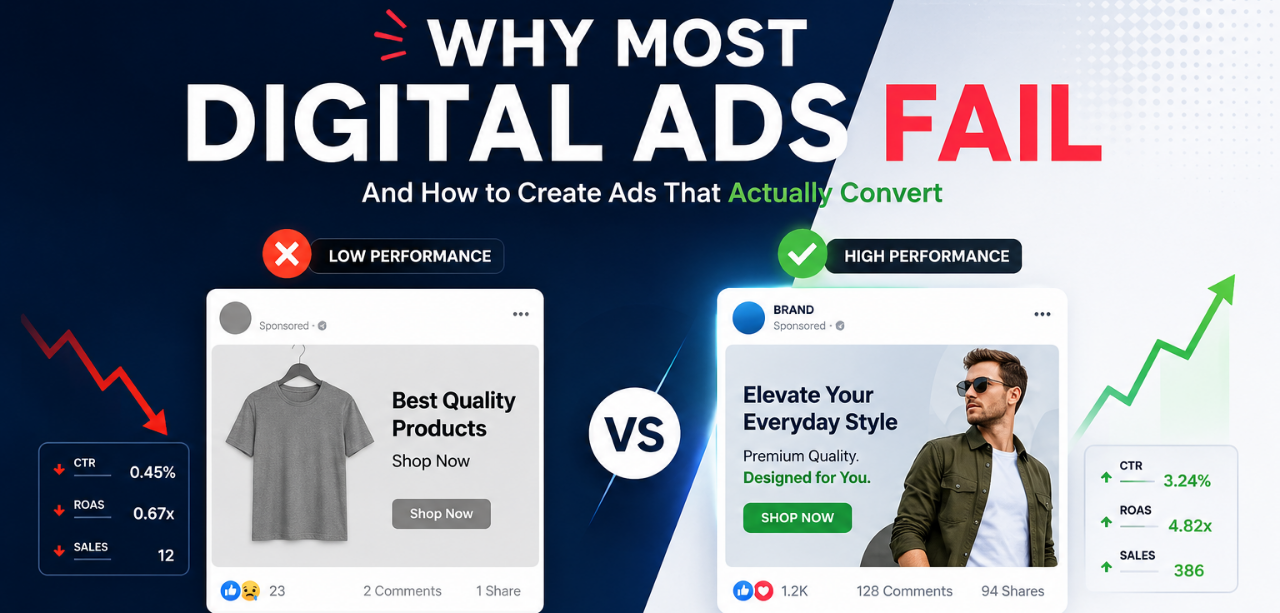
Why Most Digital Ads Fail
Many businesses pour thousands of dollars into digital advertising every month, expecting a steady stream of sales in return. Then the results come in, and they
Ready to Transform Your Advertising Strategy?
Join thousands of advertisers who trust Performoo to optimize their campaigns and maximize revenue.